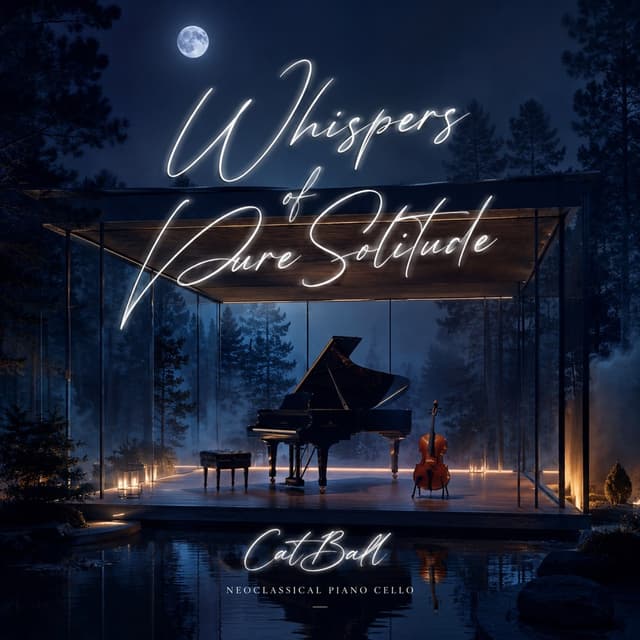
When Silence Stops Waiting for an Answer
Notes on 《Whispers of Pure Solitude》
Silence is often understood as a form of absence: a sentence left unanswered, a person who has gone, a space waiting to be filled. 《Whispers of Pure Solitude》proposes another possibility. Silence need not be the hollow left by loss. It can be a complete, self-sufficient space that requires no reply.
Across six instrumental pieces, piano, cello, and strings trace this transformation. The record uses no lyrics to explain its emotions and no rain, wind, or birdsong to name its scenes. Distance, light, and breath are shaped entirely through the density between notes, the decay of resonance, and silence itself.
Solitude Without Absence|創作命題
《Whispers of Pure Solitude》is not concerned with escaping solitude, but with whether solitude must be treated as a condition in need of repair. The album's first half still preserves the shape of waiting: melodies pause in mid-air, resonance seems to search for an echo, and the space between sparse notes appears large enough to hold another person.
As the sequence unfolds, those spaces remain unfilled. There is no return of brightness, triumphant reprise, or emotional victory. Instead, the music descends and stays at its new depth. Change arrives not because loss is reversed, but because the listener gradually discovers that the space itself is enough.
“Pure” therefore does not mean spotless or flawless. It means solitude without a demand for response: unmixed with regret, without the assumption of reunion, and without treating silence as a sentence still waiting to be completed.
Piano, Strings, and Air|聲音設計
The piano establishes the architecture. Single notes, chords, and slowly decaying tails give every strike a distinct boundary. Cello and chamber strings behave like shadows within that space, sometimes approaching the melody and sometimes receding until only texture remains. The air between them is not background; it is the album's essential third instrument.
The first two tracks centre on D minor. From the third track onward, that centre descends to C minor and remains there through the finale. Tonal brightness falls at the same point and never returns to the level of the opening. This is an irreversible line of descent: the album does not enter darkness temporarily and come back, but builds a new equilibrium within it.
Each piece has its own dynamic profile, yet all six resist overfilling the frame. The sound can be densely active or nearly motionless. What unifies the record is not a fixed speed, but patience with decay, distance, and resonance.
Chapter I|Light and Echo: Tracks 01–02
〈Prelude of Fading Light〉opens with the sparsest onset pattern on the record. Its brighter energy arrives early, then gradually narrows; each note waits for the previous one to disappear before the next enters. This is not a literal portrait of sunset, but the measured pace at which light withdraws from a room.
〈Echoes in the Silent Corridor〉remains in D minor while becoming the album's most dynamically even piece. Its echo does not diminish as expected, but sustains the corridor's depth with almost unchanged force. The ending does not fade. It stops while sound still has strength, allowing the corridor to seem as though it continues beyond the music.
Together, the two pieces establish the act of waiting. The first waits for the next note; the second waits for an echo to dissolve. Neither receives a clear answer, but both prepare the entrance to the descent that follows.
Chapter II|Descent and Dissolution: Tracks 03–04
〈Nocturne in Minor Frequencies〉contains the album's densest rhythmic activity. The nocturne no longer offers rest; it behaves like an inner motion that cannot stop. Piano and low strings overlap continuously, carrying both harmony and colour into the lower, darker region of C minor.
〈Shadows on Fading Strings〉opens the texture again. String lines rise repeatedly and return with less weight each time; across the final half-minute, they recede towards near-silence. It is the album's only ending that truly dissolves. Most of the other pieces stop, but this one allows sound to complete the full process of leaving.
Tracks three and four form the record's hinge: first, a sleepless nocturne completes the descent; then, fading strings release the need to wait. The disappearance is neither dramatized nor rewarded with a new theme. It is simply allowed to happen.
Chapter III|Distance and Breath: Tracks 05–06
〈Distance Between Stars〉is the fastest piece on the record, yet near its centre it opens an eleven-second low-energy void. Speed creates the illusion of pursuit; the gap reveals the true scale of distance. Two voices may move forward at once without cancelling the space between them.
〈Serenade of the Solitary Earth〉does not restore D minor or the brightness of the opening. Instead, the finale unfolds in C minor with the widest dynamic range on the album. Piano and strings move from near-whisper to filling the room, then return inward. The music does not leave the depths, but finally learns to breathe fully there.
A serenade traditionally assumes a recipient. This piece gives that role to “the solitary Earth.” The music no longer faces a window and waits for someone to appear, nor does it reserve a place for a second voice. It returns every available space to itself.
The Meaning of Pure Solitude|沒有缺席的孤獨
Loneliness is organized around absence: a missing person, a missing answer, a voice that should have continued. Solitude can have another structure. Once the work stops treating empty space as a deficit, silence no longer requires a cure, and distance no longer means loss.
The album never returns to its higher tonal centre, never fills the central void in track five, and never summons the dissolving strings of track four back into view. It refuses to prove wholeness through recovery. Instead, wholeness becomes possible after an irreversible descent.
《Whispers of Pure Solitude》leaves behind not a person waiting for an answer, but a space that has stopped asking. When the sound ends, nothing arrives late and nothing remains missing. Silence simply returns to where it has always belonged, and the music is complete.