Nine Questions, No Answers
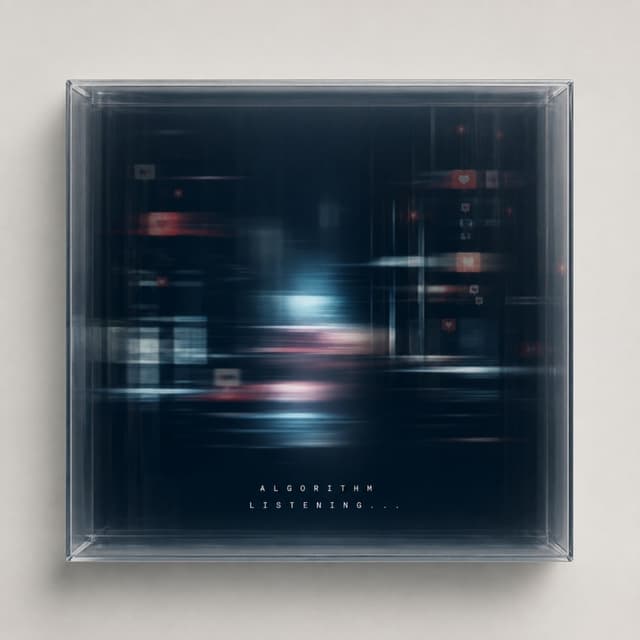
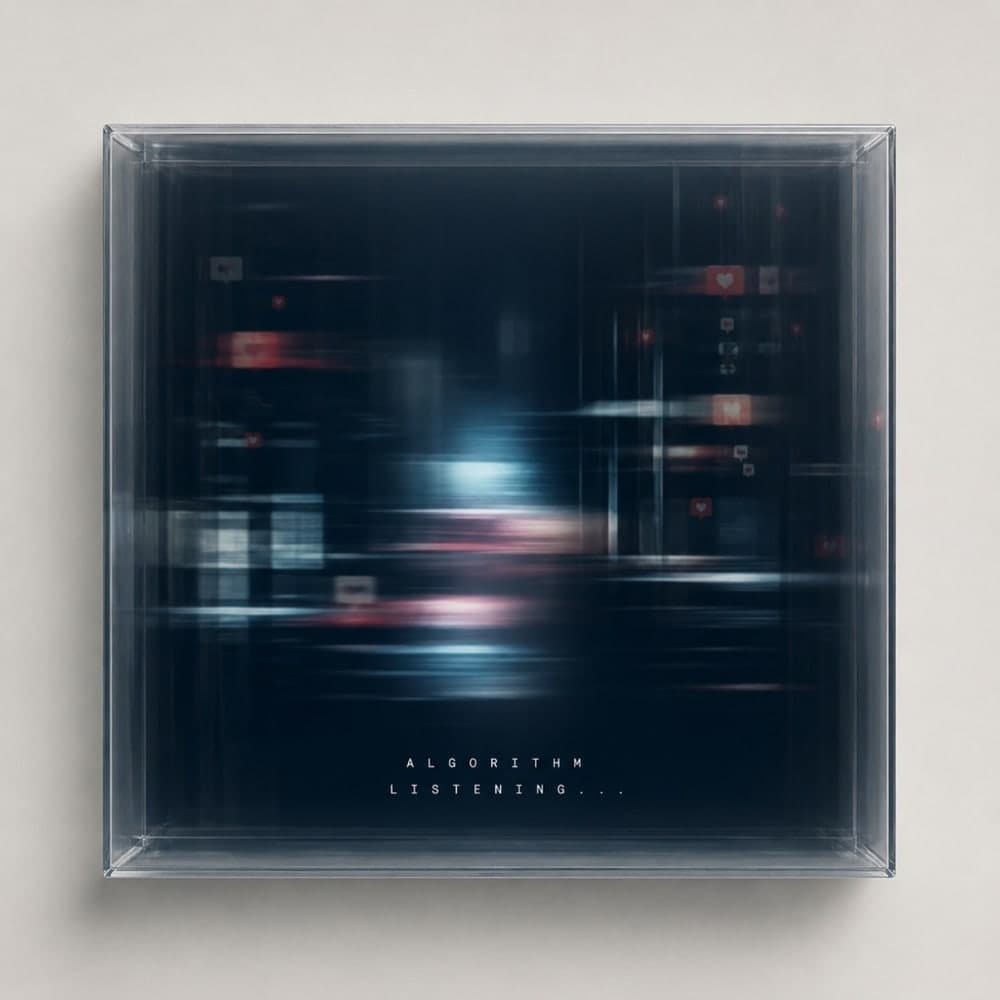
Algorithm Listening
*If I put the phone down tonight / Would I even exist*
This line is in the first track.
The second track rephrases it and asks again. The third asks once more. The fourth, sixth, seventh, and ninth, they all ask.
Nine times.
Not a single answer.
Just Talked About Shoes
*How the hell they knew.*
3 a.m. Phone on the table. Not a single word typed, just mentioned to someone that my old shoes were wearing out. Opened the app, and the very first ad was right there. Black leather, size ten.
Even the size was right.
The sharpest part of this track isn't about eavesdropping, but about that speaker: *Says it's sleeping, but it's taking notes on every single call.* It says it's sleeping. And we actually believe it's sleeping, because the interface says "Sleeping".
And this line: *Say I'm private / Knowing that it's all a lie now.*
Everyone has tapped that "Privacy Settings" button. When tapping it, you know in your heart it's all a show, but you tap it anyway, because you feel slightly better afterwards. That's what hits the mark: it's not that we're being fooled; it's that we're playing along.
And then what I consider the most venomous line of the entire album: *Selling my paranoia to the highest bidder.*
Even your paranoia is inventory. You fear being monitored, and that fear itself is data for sale.
It doesn't try to scare you. It's almost thoughtful.
*Every word I say in the dark / Leaves a digital mark.*
Midway through the song, the vocals recede, and a voice whispers:
*If I put the phone down tonight / Would I even exist*
At the time, I treated it as just a lyric.
15-Second Dopamine Prison
Fastest. Shortest. Brightest. All three landing in the same track.
The lyrics drop *Skibidi memes in the neon light* right in. Putting stuff like this into a song is a stance in itself: no explanation, no translation. Explaining it ruins the joke, and if you know, you know.
*Attention span shattered, lost in the flight / Forget what I read, but I hold on tight.*
Can't remember, yet can't let go.
When both hold true at once, it's no longer entertainment. Entertainment leaves something behind.
Fifteen seconds isn't enough to judge if something is good; it's only enough to judge whether to keep going. And you will keep going, because you haven't even registered what you just saw.
*Feed me outrage, feed me drama, keep me insane / Until I can't even remember my own name.*
It uses *feed*. The word carries two meanings: newsfeed, and feeding. The sentence pulls out the feeding side to use. It's not me watching; something is feeding me.
Listening to this doesn't feel uncomfortable at all. It feels almost good.
*If I close the app right now / Would the silence kill me*
The second time.
Filter Bubble
*Just an endless mirror where the truth is dead.*
I used to think filtering meant blocking what you don't want. This track puts it bluntly: it's not blocking, it's feeding. Constantly feeding you things you already agree with, until you think the whole world agrees with you.
The sharpest line is this: *Everyone agrees / Or they're blocked from my view now.*
It puts the responsibility back on us. The bubble isn't built unilaterally by the platform; we block people one by one to create it ourselves. The algorithm simply learns our gestures and does it faster.
*Out there in the real world, people scream and fight / In here on my screen, I am always right.*
And the closing line is the coldest in the track: *Custom-made reality, shining so bright / While the real sun fades into the night.*
The custom-made reality shines bright, while the real sun sets. It's not that you can't see the sun; you chose the screen.
The bubble is not a wall. You bump into walls. You can't bump into a bubble, it moves with you.
*If I pop the bubble right now / Would the truth destroy me*
The third time.
Pretending to Live
The satire is densest in this track, because everything it writes about consists of verifiable behaviors.
Renting a sports car for photos. The term *Superfake watch* isn't an exaggeration; it's a real classification in the counterfeit industry, referring to replicas so accurate they require lab instruments to verify. *Dupe lifestyle* is also an established term.
*Post it on the feed, get ten thousand likes / Nobody knows I'm eating instant noodles at night.*
Then comes the funniest and most tragic line:
*Three hours editing a ten-second reel / Adding fake reflections to make it look real.*
Three hours, adding fake reflections, just to make a fake clip look more real. The absurdity stacked here is two-layered: creating fake details to appear real, when that "real" itself is fake.
*Algorithm rewards the most shiny appeal / While my real bank account forgets how to feel.*
Going broke to look rich. *Paid with a maxed-out card now.*
After the lights go off:
*Who am I / When no one's around*
Even the framing of the question changes this time. Earlier it asked "do I even exist"; here it asks "who am I". The same thing, asked from another angle.
The fourth time.
Algorithmically Deep in Love
*Ninety-nine percent match.*
Ninety-nine percent. The number itself is a joke. Nobody asks what that missing one percent is, nor how the ninety-nine was calculated. People see the number and believe it.
The lyrics lay out the formula: *Shared the same music, took the same road.* Same music taste, same daily route. That's it. Fate turns out to be just two or three overlapping tags.
*Thought it was destiny, thought it was fate / Algorithm planned out our very first date.*
On day twenty-eight, messages stop at "Read", followed by a quiet unmatch.
*I was just a profile in your daily stack.*
One card in a daily stack.
And the most stingingly sharp line is this:
*Did you unmatch me / Or did the server crash*
You can't even tell whether you were rejected or hit a server glitch. This is a pain unique to our era. In the past when dumped, at least you knew you were dumped.
This track doesn't ask "what if I stop". It asks:
*If the algorithm matched us wrong / Why did I write / This stupid heartbroken song*
If it calculated wrong, why does my heart still ache?
This is the most honest line on the entire album. It admits one thing: even when you know it's calculation, it still hurts all the same. Knowing the mechanism won't save you.
Pings of Panic
*Red badge counter rising to a hundred and three.*
One hundred and three red badges. This number is spot on, because the anxiety of red dots has nothing to do with content, only with the number. Nobody clears them out of a desire to know what those one hundred and three items are.
*Breaking news, breaking drama, breaking news on me.*
Three *breaking*s lined up together. The exact same word cascades from major international events down to "gossip about me", without a pause. In the notification bar, their font sizes are identical.
*Checking my lock screen twenty thousand times.*
*Making every fake alert feel so real and false.*
So real and false. Grammatically contradictory, but precisely described: even when you know it's a marketing push notification, your heart still skips a beat.
What I fear isn't bad news. What I fear is that single second where I don't know what it is. Work, friends, bills, ads, or that person. All possibilities coexisting at once.
It doesn't need to frighten you. It only needs to keep you not knowing.
*If I turn off notifications today / Would the world forget me*
The sixth time. Asked most plainly this time: will the world forget me?
Outrage Farm
*Nobody cares if it's real or a lie.*
No need to verify, attack first. And the lyrics highlight one specific detail: *Flame the victim too.* Flames the victim along with the rest.
This stroke hits home. Online outrage is never directed at the perpetrator; it targets whoever is easiest to attack. Victims are usually the easiest.
*Keyboard warriors / Type a toxic line for the clout now.*
For clout. Outrage isn't the goal; it's the means.
And then comes the coldest passage of the entire album:
*Turns out the post was fake, a total setup lie / Nobody apologizes, nobody asks why / Pretend I never saw it, delete my comment quick / Scroll down to the next post and start another attack.*
Nobody apologizes. Nobody asks why. Delete the comment, pretend you never saw it, scroll down, attack the next one.
These four lines portray a fully matured social behavior where every step corresponds to an interface function: deleting a comment is a button, scrolling down is a gesture. The interface designed "zero accountability" into two simple actions.
Outrage went nowhere. It was simply harvested.
Even my most genuine emotions are products.
*If the mob turns on me tomorrow / Would anyone defend*
The seventh time. And the person asking this time is the very one who was just hurling attacks.
Doomscrolling Infinite
This track features the best line on the album, brilliant because it offers no commentary, simply placing two things side by side:
*Fibermaxxing, looksmaxxing, digital rage / War strikes, wildfires, stock market crash.*
Dietary fiber, looksmaxxing, war, wildfires, stock market crash.
Within a single line. Same tone, same length, same weight.
That is the exact feed you scroll through. One tile teaches you to eat more fiber; the next tile shows a city burning. Your finger swipes past both with equal force. On screen, they really are the exact same size.
Nothing more needs to be said. Juxtaposing them is already the ultimate critique.
*Depression hits / Though none of these disasters got a thing to do with me.*
I re-read this line several times. It doesn't say those disasters don't matter. It says those things have nothing to do with me, yet I'm drained all the same. This is called borrowed despair: grieving for the entire planet, only to go to work tomorrow as usual.
*Two hours of sleep before work today.*
*One hour of sleep.*
*Five A.M. sun is rising up.*
The sleep hours in the lyrics dwindle continuously. Two hours, one hour, then sunrise.
This track doesn't ask "what if". It asks: *Why did I scroll all night for this trash.*
No hypotheticals left, only the aftermath.
Persona 2.0
*Delete account. Digital detox. System rebooting.*
When the words "digital detox" were written into the song, they already came with quotes attached. It's a product term, an experience you can purchase, an act you can photograph and post.
Delete account, throw away history, new name, clean phone.
*Five minutes in / Algorithm recognized my typing habit.*
Five minutes in. What recognized him wasn't the account, but his typing habits.
*Biometric fingerprint, eye tracking light / You can change your username, change your avatar / Algorithm knows exactly who you really are.*
You can change your name, change your avatar, swap out everything you thought was "you". It identifies how you type, what makes you pause, what time you're still awake: things you never even considered hiding.
*Thought I reincarnated / Just Persona two point zero now.*
Counting oneself by version numbers. 2.0 isn't a new person; it's the next update of the exact same product.
Only two places on the whole album sound like good news. One is the moment of being fed full; the other is right here: those five minutes of thinking you escaped.
This setup is brutal: the fake escape sounds bright, while the real one isn't.
*If I delete my life right now / Would the code forget me*
The ninth time. Nine songs, asked nine times, not a single answer.
Shutdown Command
This track doesn't ask.
*I clicked the hard reset today / And the algorithm faded / Far away.*
Unplug the router. Hold down the power button. Watch the screen go dark. Step outside, feel the real wind on your skin.
*No more dopamine prison, no more fake clout / No more algorithm telling me how to feel / Just me in the silence, where everything is real.*
It even looks back and counts: *Ten tracks of algorithm traps in my mind.* It also explicitly says *No more shoes listening in the dark*, tying back to the very first track.
System shutdown complete. Hard reset. Zero. Zero.
A click.
Alright, sigh of relief.
Only after a few seconds does it feel wrong. I heard this exact placement at the very beginning. Not similar, the exact same placement.
Ten tracks loop full circle. The final "shutdown" moment lands in the exact same spot as the first track.
The lyrics say we stepped out.
The music says we returned to the start.
By the third or fourth listen, one detail floats to the surface.
The skeleton of all ten songs is identical. The same opening short line, the same two-word repetition chant, the spoken word section in the exact same spot, the question in the exact same spot. Even the track lengths are nearly identical, two minutes and change, without exception.
An album criticizing formulas is itself a formula.
At first I thought it was laziness. Then I realized: if you want to write an album about "all content being flattened into the exact same shape", you only have two options: write endlessly varied music for contrast, or let the entire album turn into that shape.
It chose the second path. That's why after listening, you won't remember any single track as particularly standout.
Just like scrolling for two hours without recalling anything you watched.
This album is no prophecy. Everything it details has already happened, unfolding even faster than the lyrics describe.
Over half of all countries now ban phones in schools. More than a hundred education systems are locking phones away in boxes one by one. Ten years ago, this would have been dismissed as a joke.
Some nations pass laws prohibiting anyone under sixteen from creating social media accounts. Some have announced it; some have already put it into effect.
Something originally designed to connect everyone now requires legislation to pull people away from it.
And the method used is quarantine. First age: under sixteen prohibited; then location: forbidden in schools, locked in boxes; next up is probably time slots.
This sequence of steps isn't new. We all lived through it just a few years ago, except back then we were dealing with a virus.
Unspoken, yet made clear by actions: that thing is now treated as something contagious. Exposure must be controlled, minors protected, and clean zones designated.
Back then, the fear was it entering the body. This time, the fear is it entering attention.
Certain states mandate that before opening those apps, you must dismiss a mental health warning first. Like the warning label on a cigarette pack.
And in the courts, a single class action suit alone has a backlog of nearly three thousand cases, all parents suing platforms, claiming the feed-by-design harmed their children. Some platforms chose to settle. Settling means: no admission of guilt, but paying up.
*Selling my paranoia to the highest bidder.*
That line from the lyrics originally sounded like hyperbole.
There's another set of numbers that I find colder than all of the above.
Last year's Word of the Year was "AI slop". Two separate dictionaries selected it simultaneously. A phrase describing machine-generated junk content became the single word best capturing the world for an entire year.
More than half of all internet traffic is no longer human.
Surpassed for the very first time. Meaning, statistically speaking, the page you're scrolling right now is more likely written by machines for machines to watch.
*Just an endless mirror where the truth is dead.*
That line from the third track was written about filter bubbles. But placed here it remains just as valid, if not sharper: the mirror is still there, but what it reflects is no longer human.
We always thought the problem was "the algorithm knows us too well."
Looking at those numbers, I don't think so anymore. The problem is it doesn't really need us anymore. Content can be generated by machines, traffic driven by machines, interaction simulated by machines. Humans remain in this system, gradually demoted from protagonists to samples.
It is still watching you.
But the reason it watches you is no longer because you have anything worth looking at.
Nine questions, yet really just one.
*Would I even exist. Would the world forget me. Would anybody care. Would the code forget me.*
Translated into one line: when nothing is watching me, do I still exist?
What these ten tracks truly fear isn't being monitored at all.
Being watched is bearable, even slightly warm, like being remembered. The real fear is the flip side: after powering off, will no one know how my day went?
That's not violation anymore. That's being lonely enough to prefer being watched by a machine.
That's why the tenth track turns out the way it does. It claims it's free, saying it with force, *free* repeated three times. But the music drops you right back at the starting line.
It's not that the song is lying.
It's that every single time, we truly believe we can walk away this time.
Writing up to this point, my hand has already reached for the phone.
Not trying to do anything in particular. It just reached over.
It knows what time I can't sleep. Knows what makes me pause. Knows who I gaze at for two seconds longer. It knows me better than anyone.
And yet it doesn't care about me at all.
A pair of eyes stares at you day and night, with no human behind them.
Ten tracks, each two minutes and change. Just the right length so you won't swipe away.
Even this was factored into the calculation.
